
Understanding Reactive and Proactive Extremism - The Transforming Power of Safety in Education
Marlene Bruun Lauridsen
-
Marlene Bruun Lauridsen0000-0002-7033-3746
Department of Education, UiT The Arctic University of Norway
This article examines extremism as a psychological and relational challenge, focusing on education’s role in preventing violent extremism. Drawing primarily on psychological perspectives, the article suggests that violent extremism is often rooted in emotional distress and disconnection, and in unmet needs for belonging and significance that may interact with ideological narratives.
The Transforming Power of Safety (TPS) model and the related concepts of reactive and proactive extremism are introduced as a conceptual framework to illustrate how emotional disconnection may shape pathways to violent extremism. The model suggests that emotional safety and belonging may support regulation, connection with self and others and reflective capacity necessary for democratic participation.
The discussion highlights the implications of this understanding for educational practice and argues that preventing violent extremism requires moving beyond ideological counterarguments by adopting trauma‑informed and relational approaches that foster emotional safety and strengthen the capacities supported by the TPS model. Education is understood as a humanising force with the potential to counter disconnection, strengthen democratic resilience, and address the challenges of polarisation and disinformation in contemporary society.
Keywords: violent extremism, emotional safety, Transforming Power of Safety, reactive and proactive extremism, democratic resilience
Reaktiv og proaktiv ekstremisme som pedagogisk utfordring
Denne artikkelen undersøker ekstremisme som en psykologisk og relasjonell utfordring, med særlig vekt på utdanningens rolle i forebygging av voldelig ekstremisme. Med utgangspunkt hovedsakelig i psykologiske perspektiver antyder artikkelen at voldelig ekstremisme ofte har røtter i emosjonell belastning og frakobling, samt udekkede behov for tilhørighet og betydning som kan virke sammen med ideologiske narrativer.
The Transforming Power of Safety (TPS)-modellen og de tilhørende begrepene reaktiv og proaktiv ekstremisme introduseres som et konseptuelt rammeverk for å belyse hvordan emosjonell frakobling kan være en vei inn i voldelig ekstremisme. Modellen antyder at emosjonell trygghet og tilhørighet kan styrke emosjonell regulering, kontakt med seg selv og andre, og åpne opp for refleksjonen som er nødvendig for demokratisk deltakelse.
Diskusjonen belyser hvilke implikasjoner denne forståelsen har for pedagogisk praksis, og argumenterer for at forebygging av voldelig ekstremisme krever mer enn ideologiske motargumenter. Traumebevisste og relasjonelle tilnærminger kan fremme emosjonell trygghet og styrke kontakten med seg selv, fagstoffet og andre, slik TPS-modellen fremhever. Utdanning forstås som en humaniserende kraft med potensial til å motvirke frakobling, styrke demokratisk motstandskraft og møte utfordringene knyttet til polarisering og desinformasjon i dagens samfunn.
Nøkkelord: voldelig ekstremisme, emosjonell trygghet, Transforming Power of Safety, reaktiv og proaktiv ekstremisme, demokratisk motstandskraft
Research on violent extremism has increasingly emphasised that radicalisation cannot be explained by ideology alone. While radicalisation is frequently used to describe pathways into extremism, it is a broad concept that may carry stigmatising connotations. In this article, radicalisation refers to processes through which individuals become increasingly receptive to rigid ideological beliefs or identities (Borum, 2011). Extremism is a contested concept that can be understood in different ways. From a psychological perspective, Kruglanski and Moskalenko (2025) conceptualise extremism as a state of motivational imbalance in which one need, goal or concern becomes dominant at the expense of competing considerations. In the present article, the focus is specifically on violent extremism, understood as the endorsement or use of violence to advance ideological, political, or religious objectives and as incompatible with fundamental democratic principles (NOU, 2024: 3). The focus is not ideological exploration itself, but how emotional vulnerability and ideological narratives may intertwine in pathways to violent extremism – a distinction that is particularly relevant in educational contexts, where critical thinking and identity exploration are a natural part of development (Sjøen, 2020; Sjøen & Jore, 2019).
A broad interdisciplinary literature highlights how psychological needs, social contexts and ideological narratives interact in pathways into extremism. Reviews of radicalisation research (Borum, 2004, 2011) demonstrate that processes leading to violent extremism are often driven by perceived injustice, identity conflict and social marginalisation rather than by doctrinal commitment alone. McCauley and Moskalenko (2011) similarly describe radicalisation as emerging through multiple mechanisms operating at individual, group and societal levels, where experiences of grievance, belonging and moral outrage interact with ideological narratives. Motivational dynamics underlying extremist engagement, particularly the quest for significance – the human need to experience dignity, recognition and meaning – can drive individuals toward extremist groups when ordinary pathways to significance are blocked (Kruglanski et al., 2014, 2019; Kruglanski & Moskalenko, 2025; Kruglanski & Raviv, 2025). Related research highlights how identity threat, uncertainty and social disconnection increase vulnerability to violent extremism (Doosje et al., 2016; Ellis & Abdi, 2017).
These psychological and relational dynamics are also relevant to the broader educational conditions in which young people develop. In Norway, recent research points to experiences of restlessness, insecurity and increasing demands among students. Beyond national survey figures and absenteeism statistics, some students report weakened ties to their school communities (Ellis & Abdi, 2017; Wendelborg, 2024). Sense of belonging and well-being may be strained alongside rising performance pressure, individualisation and efficiency demands. Research identifies school community as crucial for learning and well-being (Allen et al., 2018; Flett, 2022; Prilleltensky, 2020; Von Heimburg & Ness, 2021). When students lose their sense of belonging and significance, not only can well-being suffer, but motivation, identity and self-worth are also at risk. Erosion of emotional safety, belonging and meaningful relationships may further contribute to disconnection from oneself and others, creating conditions in which rigid or destructive modes of thinking can become more compelling (Neff & Germer, 2017; Stahl et al., 2021).
Educational research has accordingly given increasing attention to relational conditions associated with resilience to violent extremism. Studies indicate that schools can function as protective environments when they foster safety, trust and inclusive belonging (Roffey & Boyle, 2018; Stahl et al., 2021). Such findings point to the importance of understanding extremism not only as a political or ideological phenomenon, but also as a relational and developmental challenge, inviting attention to the conditions that may make individuals receptive to such views and to how vulnerability may be reduced or exploited in recruitment processes.
Building on these insights, the article proposes a psychologically and trauma-informed framework, recognising that adverse childhood experiences (Felitti et al., 1998) may shape emotional regulation, relational trust and responses to perceived threat, without assuming that young people vulnerable to extremist narratives are traumatised. It explores how these processes, together with emotional disconnection and loss of belonging, may contribute to vulnerability to violent extremism and argues that schools can serve as important preventive and restorative arenas by facilitating emotional safety, belonging and reflective dialogue, rather than by identifying or monitoring potential extremists. The article seeks to provide educators with a conceptual and analytical framework to strengthen resilience, democratic belonging and reflective capacity in times of growing uncertainty, polarisation and disinformation.
Educational implications are explored through perspectives that understand schools as places where democratic ways of being, relating and judging are cultivated (Dewey, 1938; Arendt, 1958, 2006; Nussbaum, 2010; Biesta, 2013). In this view, prevention involves more than countering ideas: it requires creating educational conditions for human formation in which students can develop the capacity to remain connected to themselves and others, sustain compassion and ethical judgement. This involves meeting anger and withdrawal with relational presence, showing that dignity can be restored through shared understanding and dialogue.
This raises an important educational question: How can schools contribute to strengthening emotional and democratic resilience in ways that may reduce young people’s vulnerability to violent extremist narratives?
Drawing on Norwegian policy, school research and the 22 July terror attack as contextual reference points, the article develops a conceptual framework relevant to wider discussions of education and violent-extremism prevention. It uses the Breivik case as a limited illustration of how emotional and relational disconnection may become entwined with ideological narratives before introducing the Transforming Power of Safety model and the distinction between reactive and proactive extremism.
The Psychological Roots of Extremism
Extremist engagement may become more psychologically compelling in contexts characterised by identity insecurity, fear, uncertainty and constrained opportunities for reflection. Rather than reflecting inherent evil, attraction to extremism may involve a search for belonging, meaning or a sense of control in the vacuum left by emotional disconnection and identity confusion. McCauley and Moskalenko (2011) argue that radicalisation often arises from unmet psychological needs for belonging and significance – needs that emerge when ordinary paths to recognition and inclusion fail. They note that many who join extremist milieus are not ideologically driven fanatics, but individuals who find comfort in group belonging and moral certainty; fragile identity structures can thus facilitate radicalisation. Recent work also shows how disinformation that threatens gender norms increases radical intentions by activating fragile masculinity or femininity – illustrating how identity insecurity can function as a psychological catalyst for extremism (Moskalenko et al., 2025). These findings reinforce this article’s pedagogical claim: when students lack emotional safety and belonging, they may seek meaning elsewhere and adopt rigid identities to escape ambiguity, becoming more susceptible to polarised narratives that promise clarity, significance and control (Lundesgaard, 2025).
Although no single case can explain pathways into violent extremism, the Breivik case illustrates psychological and relational processes that may be relevant across different extremist trajectories, not only right-wing extremism. In his manifesto, elements of his upbringing and family history are reframed into ideological justification. His early development included prolonged separation from his father, his mother’s emotional dysregulation, and indications of neglect and fear within the caregiving environment. The resulting combination of disrupted attachment and inconsistent caregiving (Borchgrevink, 2012) contributed to a profoundly insecure developmental context (Melle, 2013).
In his writing, personal experiences of powerlessness are transformed into a collective narrative about moral decline and breakdown of a patriarchal order:
Committed fathers are crucial to their children's emotional development ... Lone motherhood stopped being a source of shame and instead became a woman’s inalienable right. This has produced generations of women-only households, where emotionally needy girls often become inadequate mothers who abuse and neglect their own children – thus perpetuating the destructive pattern. (Breivik, 2011, p. 361)
In these passages the mother’s illness and fragility are turned into symbols of societal decay. A personal wound – experienced abandonment and disconnection – is converted into ideological rage. Where reflection and relationship are absent, a psychological need to impose order through enemy images may arise. For Breivik, this culminates in a self-appointed violent mandate – ‘Justiciar Knight’ – in which he positions himself as judge and executioner on behalf of ‘future Europeans’ (Wollenberg, 2014). His posture combined withdrawal and grandiosity with deep loneliness, unresolved childhood trauma and engagement with extremist content; he sought meaning through fantasies of violence, power and recognition (Carle, 2013; Meloy et al., 2015; Pantucci, 2011; Seierstad, 2013; Wessely, 2012).
Deeyah Khan’s documentary White Right: Meeting the Enemy (2017) offers a different illustration. Some of the individuals she encounters, despite their involvement in extremist milieus, continue to express emotional vulnerability, loneliness, shame and needs for recognition and belonging. Rather than representing a purely reactive pathway, these accounts may illustrate how elements of emotional ‘warmth’ can remain present alongside more consolidated extremist beliefs. This also suggests that different forms of extremism should not be understood as fixed categories, but as psychological dynamics that may overlap or shift over time.
From an educational perspective, these examples illustrate how prolonged emotional disconnection may increase vulnerability to extremist narratives. Understanding these processes requires an integrated psychological and educational framework.
The Transforming Power of Safety
The Transforming Power of Safety (TPS) model builds on and expands the original Power of Safety (PS) model (Lauridsen, 2020, 2022) to account for different responses to vulnerability, powerlessness, and emotional disconnection. It was developed in connection with a UNOPS workshop held in 2023 in Doha on mental health and countering violent extremism, conducted in collaboration with Sophia Moskalenko. Rather than treating violent extremism as an isolated phenomenon, the TPS model frames it as one of several possible pathways through which individuals may attempt to manage psychological pain and restore meaning, control or significance.
Figure 1 illustrates the TPS model and shows how different levels of emotional safety and social engagement shape adaptive responses to vulnerability. Depending on whether individuals experience connection or disconnection, these responses may support empowerment or contribute to patterns of powerlessness and power over others – including substance misuse, self-harm and, under certain conditions, violent extremism. Digital dynamics can amplify these risks: exposure to online content that normalises self-harm or violence, and addictive patterns of social media use may interact with emotional disconnection to increase vulnerability (Kunst et al., 2026).
Figure 1
The Transforming Power of Safety (TPS)
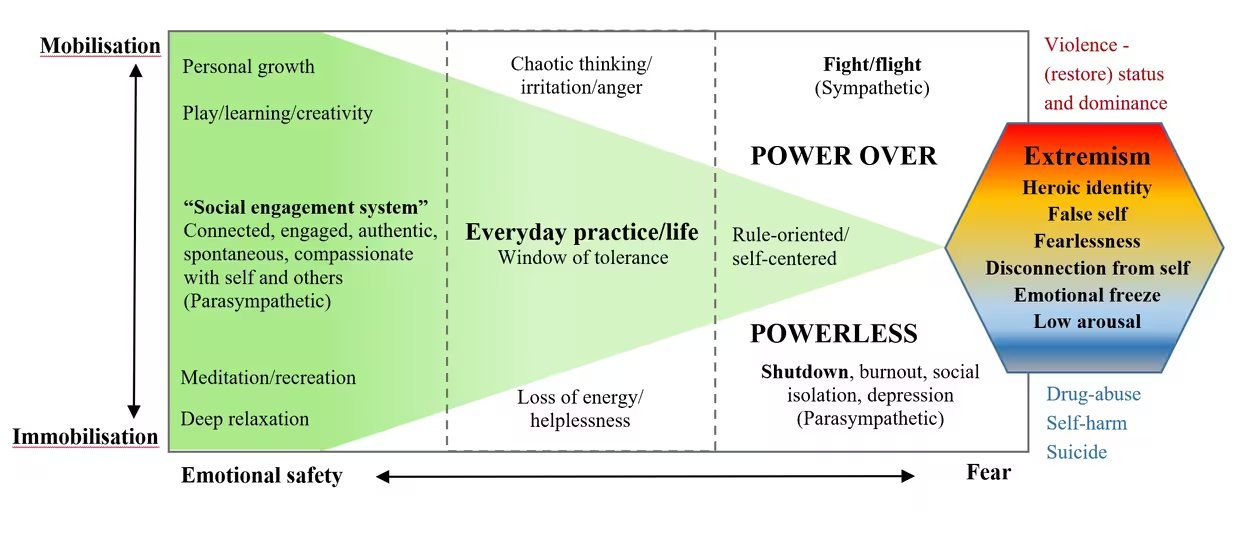
Note. The TPS model builds on and expands The Power of Safety (PS) model (Lauridsen, 2020, 2022).
The TPS model integrates insights from sensorimotor psychotherapy (Ogden, 2006), polyvagal theory (Porges, 2011), and interpersonal neurobiology (Siegel, 2012). It emphasises the foundational role of emotional safety in enabling learning, reflection and personal growth. When individuals experience emotional safety, they remain within the window of tolerance, a state in which thoughts, emotions and bodily responses are integrated. This integration supports curiosity, creativity, play and the capacity for self-reflection and relational presence. The social engagement system is mobilised, allowing individuals to stay connected to themselves and others. Emotional regulation is flexible, and experiences can be processed without overwhelming the nervous system.
When emotional safety is compromised, individuals may shift into protective survival states characterised by mobilisation or immobilisation in response to perceived threat (Lauridsen & Munkejord, 2022). These include fight (attempts to regain control), flight (avoidance), freeze (immobilisation and high arousal) and fawn (appeasement) responses (Perry & Szalavitz, 2017; Porges, 2007, 2011). Such responses are adaptive and automatic rather than deliberate, serving to restore safety and avoid helplessness. In these states, integration may be reduced. Individuals may move towards hyperarousal, marked by chaotic thinking, anger and rule-oriented control (power over), or hypoarousal, marked by shutdown, emotional numbing and withdrawal (powerlessness). These shifts are dynamic and context-dependent, reflecting attempts by the nervous system to manage perceived threat. Together these perspectives underscore that emotional safety is not merely a psychological experience, but a neurobiological condition necessary for sustainable learning, development, and relational capacity.
The following section builds on this framework by distinguishing reactive and proactive extremism as two psychological pathways through which vulnerability and emotional disconnection may become organised into violent extremist engagement.
Reactive and Proactive Extremism: A Psychological and Pedagogical Perspective
The terms reactive extremism and proactive extremism have not been formalised previously, though their underlying ideas appear in psychological, sociological and neuroscience research. This article builds on these foundations by explicitly framing the concepts in the context of extremism and linking them to pedagogical strategies. In psychological research, reactive and proactive aggression are understood as distinct but related forms of violence (Dodge & Coie, 1987). Reactive aggression is impulsive and emotionally driven, often triggered by perceived threat, pain or humiliation, and involves strong affective and physiological responses – an attempt to protect one’s integrity or dignity (Dodge & Coie, 1987; Hubbard et al., 2001; Raine, 1993). Proactive aggression, by contrast, is instrumental and goal-directed: violence is used strategically to achieve control, status or power. It is less emotional, more cognitively organised, often accompanied by moral disengagement and lack of empathy (Vitaro et al., 2002).
Both forms of extremism are rooted in vulnerability and disconnection but differ in their emotional dynamics and, thus, in their pedagogical implications. Reactive extremism is conceptualised here as emerging from emotional pain and social exclusion. It remains emotionally ‘warm’, characterised by unresolved anger, humiliation or fear, and reflects an attempt to restore meaning and significance (Kruglanski et al., 2019; Kruglanski & Moskalenko, 2025). Kruglanski and Raviv (2025, p. 3) note: ‘Denying people respect – humiliating or insulting them – is extremely hurtful and often the cause of great emotional suffering that can erupt in aggression against themselves or others.’ Many who join extremist milieus are not ideologically convinced, but seek belonging, safety, and moral clarity in a chaotic world (McCauley & Moskalenko, 2011).
Proactive extremism, by contrast, may appear emotionally ‘cold’; it reflects a state in which hope in humanity has largely been abandoned and emotional disengagement has taken hold. It represents a more ideologically motivated and cognitively rigid form of radicalisation, driven by a conviction to act ‘on behalf of truth’ that restores a sense of control and coherence. Within the present framework, proactive extremism involves a profound disconnection from vulnerable emotional experience in oneself and from the emotional reality of others, constraining access to compassion and reflective awareness of the human consequences of one’s actions. Violence is rationalised as serving a higher cause, as illustrated in the Breivik case. Under such conditions, underlying emotional pain is reframed through ideological narratives that provide coherence and externally directed meaning (Borum, 2011; Kruglanski et al., 2019; 2014). Psychologically, this process may reflect a diminished capacity to mentalise and remain in reflective contact with one's own emotional experience under conditions of chronic stress or threat (Fonagy, 2004; Perry, 2006; Twemlow et al., 2002). Arendt's (1971) notion of Gedankenlosigkeit (thoughtlessness) captures the loss of inner dialogue that makes rigid ideological certainty more compelling. Thoughtlessness is not stupidity but a collapse of reflective dialogue with oneself.
Within the TPS model, chronic stress and adversity may contribute to hypoarousal or hyperarousal, reducing emotional processing and reflective capacity. In interaction with relational, social and ideological factors, such responses may increase vulnerability to rigid worldviews or harmful action (Mbiydzenyuy & Qulu, 2024; Porges, 2007, 2011).
Together, these perspectives indicate that emotional safety is more than a psychological state; it is linked to processes that support learning, development and relational capacity, and may help explain how reactive and proactive pathways into extremism can emerge as different responses to threat, powerlessness or disconnection. If dysregulation remains relationally unsupported over time, defensive identities may become increasingly rigid and, in interaction with ideological and social influences, contribute to pathways toward proactive extremism, as conceptualised within the TPS model.
Pedagogically, the model suggests that emotional safety is not simply a precondition for learning but a transformative force that supports compassion, reflection and ethical responsibility, thereby reducing vulnerability to extremist thinking. Consistent with Kruglanski's theory, violent extremism rarely begins with ideology alone but with unmet needs for meaning, dignity and belonging; where these needs are thwarted, extremist narratives may offer compensatory identity and purpose (Kruglanski & Raviv, 2025; Lundesgaard, 2025).
At the same time, vulnerability should not be understood solely as an individual movement toward extremist narratives. Extremist groups and networks may actively appeal to and exploit needs for belonging, recognition, certainty or significance through online environments, peer relationships and other social contexts. What initially appears as unconditional belonging may gradually become conditional on conformity, isolation or acceptance of increasingly rigid and violence-legitimising narratives. Vulnerability and recruitment should therefore be understood relationally, as psychological needs interact with environments that may reinforce or exploit them (Vale, 2025). For schools, this highlights how needs for belonging, trust, identity and recognition can be manipulated in recruitment processes.
Pedagogical Implications – The Search for Meaning and the Ethics of Belonging
Understanding extremism as an educational challenge requires recognising that prevention extends far beyond ideological counterarguments or behavioural management. As Borum (2004, 2011) and Kruglanski et al. (2019) emphasise, radicalisation is primarily psychological and relational, not purely intellectual.
Understanding extremism as an educational challenge requires recognising that prevention extends far beyond ideological counterarguments or behavioural management. As Borum (2004, 2011) and Kruglanski et al. (2019) emphasise, radicalisation is primarily psychological and relational, not purely intellectual.
Nussbaum (2001) reminds us that emotions are the foundation of reason, shaping judgement and opening pathways for moral imagination. This understanding aligns with educational traditions that view democracy as a lived practice rather than merely a body of knowledge: Dewey (1938) argued that democratic dispositions emerge through participation in democratic communities, while Arendt (1958) saw education as the space where each new generation is introduced to a shared world. Democratic education therefore depends upon cultivating emotional capacities such as empathy, critical reflection and perspective-taking (Nussbaum, 2001, 2010).
The TPS model, building on the original PS framework (Lauridsen, 2022) and Perry and Szalavitz’s (2017) Regulate–Relate–Reason sequence, suggests that emotional safety can be transformative. Reactive extremism points primarily to the need for emotional safety, belonging, trust and recognition (Regulate–Relate), whereas proactive extremism also highlights the need to be taken seriously in reflective and ethical dialogue (Reason). This reflective dimension resonates with Arendt’s (1971) notion of inner dialogue – ‘me and myself’ – without which moral judgement may weaken and destructive ideologies may become more compelling. Within the window of tolerance, cognitive flexibility and moral reasoning are more possible; outside it, protective modes such as fight, flight, freeze or fawn may dominate. Prevention in education thus depends on restoring coherence between feeling, thought and action – empowering the human and moral self.
This article focuses primarily on violent extremism because it directs attention toward the conditions under which psychological vulnerability, relational disconnection and ideological narratives may culminate in violence rather than ideological commitment alone (Borum, 2004, 2011). In educational contexts, identity exploration and engagement with controversial ideas are legitimate parts of democratic formation. Rather than treating ideological exploration as inherently problematic, schools are encouraged to create educational environments that strengthen emotional safety, belonging, reflective judgement and the capacity to engage critically with diverse perspectives (Ellis & Abdi, 2017; Horgan et al., 2024; Roffey & Boyle, 2018; Stahl et al., 2021). From this perspective, preventing violent extremism is less about countering ideas than about addressing why rigid ideological narratives become psychologically compelling. Educational practice therefore involves meeting anger, withdrawal and experiences of exclusion with recognition, dialogue and opportunities for meaningful participation – restoring dignity through relationships rather than confrontation (Horgan et al., 2024; Lauridsen & Munkejord, 2022).
Belonging can function as a restorative force when relational safety and recognition are established (Cohen, 2022). Education becomes an ethical arena where difference is tolerated, curiosity encouraged, and belonging practiced as an inclusive process: ‘you are valued within the community’. Through collective practices such as shared rituals and structured dialogue, educators can foster a culture of inclusion that strengthens identity and community (Baumeister & Leary, 1995).
National prevention strategies, such as the Norwegian Official Report on Extremism (NOU, 2024: 3), rightly emphasise democratic resilience, civic competence and cross-sector collaboration. The report recognises psychosocial vulnerability and adverse life experiences among those at risk of violent extremism. However, trauma-informed perspectives are less explicitly integrated into the overarching pedagogical recommendations. This reflects a broader structural tendency to treat democratic education and emotional–relational development as separate domains (Bacigalupa Albaum, 2026).
A trauma-informed and relational approach should not be used to identify or monitor potential future extremists. Therapeutic and security-oriented approaches to preventing violent extremism may individualise political violence, pathologise dissent, overburden educators and undermine trust between students and professionals (Durodie, 2016; O'Donnell, 2018; Taylor & Soni, 2017). Schools may nevertheless support universal prevention by fostering safety, belonging, and dialogue – approaches that may help reduce vulnerabilities (Borum, 2004; Ellis & Abdi, 2017; Horgan et al., 2024; Roffey & Boyle, 2018; Stahl et al., 2021). Withdrawal, isolation, self-harm, aggression and attempts to regain control may reflect distress, powerlessness and disconnection rather than extremism. When unsupported over time, such distress may be associated with mental health difficulties, self-harm, interpersonal violence or increased receptivity to rigid, violence-legitimizing narratives. One example of how curiosity, dignity and human connection may create space for reflection, whereas confrontation may reinforce rigid worldviews, can be found in Deeyah Khan’s 2017 documentary White Right: Meeting the Enemy.
Vulnerability, self-hate and shame often drive individuals toward feelings of heroism and significance, especially when social contexts leave them powerless. Within the present conceptual framework, reactive and proactive extremism may be understood as two dysregulated states: the emotionally overwhelmed and the emotionally detached (Raine et al., 1996; Vitaro et al., 2002). The first seeks protection and recognition through rage and belonging, while the second seeks order through control and moral purity. In both cases, the model suggests that disconnection from one’s own vulnerability and from others may be involved.
A trauma-informed pedagogy shifts prevention from control to curiosity and from discipline to dialogue by addressing the emotional dynamics that shape young people’s thoughts and behaviours. Rather than asking only, ‘What is wrong with this student?’ it asks, ‘What may this student be protecting, and what conditions would make reflection, trust and participation possible?’ Restorative practices, including mindfulness and structured dialogue, may help repair emotional and social fractures while supporting perspective-taking, compassion, tolerance for complexity and responsibility through connection rather than domination (Aldous & McLeary, 2017; Lauridsen, 2022).
Pedagogically, the task becomes to restore this connection – through relational safety, recognition and reflective dialogue – so that emotion, thought and action can form an integrated ethical whole. This is not only prevention but the creation of conditions for personal growth, mental health and democratic participation. By emphasising belonging, emotional regulation and meaning-making, schools can help counter the existential loneliness and alienation that create fertile ground for extremism (Kruglanski et al., 2019).
Conclusion
Extremism rarely develops in isolation but emerges within relational and emotional landscapes where safety and belonging are fractured and reflection is constrained. This article’s contribution is to conceptualise reactive and proactive extremism as two intertwined, though distinct, pathways through which vulnerability and emotional disconnection may become organised into violent extremist engagement. By linking these concepts to the Transforming Power of Safety model, the article highlights their different emotional dynamics and corresponding pedagogical implications.
The TPS model foregrounds safety as an active, generative force. Emotional safety and belonging support connection to oneself and others, relational trust, reflective capacity and democratic engagement. Safety is thus both the ground and the engine of educational resilience, helping learners withstand polarisation and disinformation.
When these conditions are absent, individuals may disconnect from vulnerable aspects of themselves and construct what the model describes as a false self as a protective mechanism. This defensive identity can take the form of a heroic identity that offers significance and control while enabling the justification of violence. Extremist narratives may then function as compensatory frameworks in the context of adverse experiences, unresolved emotional distress, identity disruption and isolation. In line with Arendt, the collapse of inner dialogue may weaken moral judgement, underscoring the importance of fostering critical reflection.
Prevention in education is therefore not primarily about countering ideology but about restoring the inner dialogue between feeling, thought and responsibility. Schools that cultivate safe, relational environments and encourage reflective practices can support connection to self and others, strengthen democratic participation, and reduce vulnerabilities to polarisation and extremist narratives.
This is neither quick nor simple: it requires patience, persistence and faith in the transformative power of small, meaningful actions – a kind word, a smile or a gesture of acknowledgement – that can foster connection and belonging and help counter the isolation that may fuel extremism. At the same time, this responsibility cannot rest solely on individual educators. Educational systems, school leadership and teacher education must prioritise trauma-informed and relational pedagogies that foster emotional regulation, belonging and critical reflection. In doing so, schools can transform experiences of disconnection into opportunities for growth, ethical responsibility and resilience, functioning as a counterforce to exclusion, polarisation and powerlessness.
At a systemic level, this may include integrating trauma-informed and relational principles into teacher education, school-wide routines for relational support and restorative dialogue, opportunities for meaningful student participation, and structures that enable educators to respond consistently to exclusion, conflict and emotional distress without treating students as security risks.
Ultimately, preventing extremism is a profoundly humanising endeavour. It involves creating the psychological, relational and moral conditions in which young people can belong without excluding, feel without attacking and think without fear. This is the transformative power of safety – and the essence of education as a humanising force for democratic resilience.
References
Aldous, G., & McLeary, J. (2017). The work [Film]. Blanketfort Media. https://insidecircle.org/
Allen, K., Kern, M. L., Vella-Brodrick, D., Hattie, J., & Waters, L. (2018). What schools need to know about fostering school belonging: A meta-analysis. Educational Psychology Review, 30(1), 1–34. https://doi.org/10.1007/s10648-016-9389-8
Arendt, H. (1958). The human condition. University of Chicago Press.
Arendt, H. (1971). Thinking and moral considerations: a lecture. Social Research, 38(3), 417-446. https://www.jstor.org/stable/40970069
Arendt, H. (2006). Between past and future. Penguin.
Bacigalupa Albaum, A. (2026). Preventing Violent Extremism through Education: Policy Lessons from Norway. Nordic Journal of Comparative and International Education, 10(2). https://doi.org/10.7577/njcie.6463
Baumeister, R. F., & Leary, M. R. (1995). The Need to Belong: Desire for Interpersonal Attachments as a Fundamental Human Motivation. Psychological Bulletin, 117(3), 497-529. https://doi.org/10.1037/0033-2909.117.3.497
Biesta, G. J. J. (2013). The beautiful risk of education. Paradigm Publishers.
Borchgrevink, A. S. (2012). En norsk tragedie: Anders Behring Breivik og veien til Utøya. Gyldendal.
Borum, R. (2004). Psychology of Terrorism. Department of Mental Health Law and Policy, The University of South Florida. https://www.ojp.gov/pdffiles1/nij/grants/208552.pdf
Borum, R. (2011). Radicalization into Violent Extremism I: A Review of Social Science Theories. Journal of Strategic Security, 4(4), 7-36. https://doi.org/10.5038/1944-0472.4.4.1
Breivik, A. B. (2011). 2083: A European declaration of independence.
Carle, R. (2013). Anders Breivik and the death of free speech in Norway. Society, 50(4), 395-401. https://doi.org/10.1007/s12115-013-9677-6
Cohen, G. L. (2022). Belonging: The Science of Creating Connection and Bridging Divides (Vol. 269). PWxyz, LLC.
Dewey, J. (1938). Experience and education. Kappa Delta Pi/Touchstone.
Dodge, K. A., & Coie, J. D. (1987). Social-Information-Processing Factors in Reactive and Proactive Aggression in Children's Peer Groups. Journal of Personality and Social Psychology, 53(6), 1146-1158. https://doi.org/10.1037/0022-3514.53.6.1146
Doosje, B., Moghaddam, F. M., Kruglanski, A. W., de Wolf, A., Mann, L., & Feddes, A. R. (2016). Terrorism, radicalization and de-radicalization. Current Opinion in Psychology, 11, 79-84. https://doi.org/10.1016/j.copsyc.2016.06.008
Durodie, B. (2016). Securitising Education to Prevent Terrorism or Losing Direction? British Journal of Educational Studies, 64(1), 21-35. https://doi.org/10.1080/00071005.2015.1107023
Ellis, B. H., & Abdi, S. (2017). Building Community Resilience to Violent Extremism Through Genuine Partnerships. The American Psychologist, 72(3), 289-300. https://doi.org/10.1037/amp0000065
Felitti, V. J., Anda, R. F., Nordenberg, D., Williamson, D. F., Spitz, A. M., Edwards, V., Koss, M. P., & Marks, J. S. (1998). Relationship of childhood abuse and household dysfunction to many of the leading causes of death in adults. The Adverse Childhood Experiences (ACE) Study. American Journal of Preventive Medicine, 14(4), 245-258. https://doi.org/10.1016/s0749-3797(98)00017-8
Flett, G. L. (2022). An Introduction, Review, and Conceptual Analysis of Mattering as an Essential Construct and an Essential Way of Life. Journal of Psychoeducational Assessment, 40(1), 3-36. https://doi.org/10.1177/07342829211057640
Fonagy, P. (2004). Affect regulation, mentalization, and the development of the self. Karnac.
Horgan, J., Lorig, C., Borum, R., Allely, C. S., & Herrenkohl, T. I. (2024). Understanding and preventing violent extremism in school settings. Journal of School Psychology, 106, 101346. https://doi.org/10.1016/j.jsp.2024.101346
Hubbard, J. A., Dodge, K. A., Cillessen, A. H. N., Coie, J. D., & Schwartz, D. (2001). The Dyadic Nature of Social Information Processing in Boys' Reactive and Proactive Aggression. Journal of Personality and Social Psychology, 80(2), 268-280. https://doi.org/10.1037/0022-3514.80.2.268
Khan, D. (2017). White Right: Meeting the Enemy [Video]. YouTube. https://youtu.be/hvt5ScfjpDo?si=pyTr0r5Ga96auCvx
Kruglanski, A. W., Bélanger, J. J., & Gunaratna, R. (2019). The three pillars of radicalization: needs, narratives, and networks (1st ed.). Oxford University Press. https://doi.org/10.1093/oso/9780190851125.001.0001
Kruglanski, A. W., Gelfand, M. J., Bélanger, J. J., Sheveland, A., Hetiarachchi, M., & Gunaratna, R. (2014). The Psychology of Radicalization and Deradicalization: How Significance Quest Impacts Violent Extremism. Political Psychology, 35(S1), 69-93. https://doi.org/10.1111/pops.12163
Kruglanski, A. W., & Moskalenko, S. (2025). The Psychology of the Extreme (1st ed., Vol. 1). Routledge. https://doi.org/10.4324/9781003472476
Kruglanski, A. W., & Raviv, D. (2025). Quest for significance: harnessing the need that makes the world go round. Routledge. https://doi.org/10.4324/9781003410706
Kunst, J. R., Obaidi, M., Gollwitzer, A., Brandtzæg, P. B., Hinrichs, Y., Saini, N., & Schroeder, D. T. (2026). Intelligent Systems, Vulnerable Minds: A Framework for Radicalization to Violence in the Age of AI. Personality and Social Psychology Review, 30(3), 395-426. https://doi.org/10.1177/10888683261430089
Lauridsen, M. B. (2020). Læring i sirkel [Learning in a circle]. In B. Norbye & A.-L. Thoresen (Eds.), Forskning og kunnskapsutvikling i helsefaglig profesjonsutdanning (pp. 31–54). Orkana Akademisk. https://doi.org/10.33673/OOA20212/2
Lauridsen, M. B. (2022). Interpersonal competence in challenging encounters: Towards a paradigm shift in human services – Creating conditions for professional development through action research and trauma-informed restorative practice [Doctoral dissertation, UiT The Arctic University of Norway]. Munin. https://hdl.handle.net/10037/26771
Lauridsen, M. B., & Munkejord, M. C. (2022). Creating Conditions for Professional Development through a Trauma-Informed and Restorative Practice. Social Work, 67(2), 135-144. https://doi.org/10.1093/sw/swac005
Lundesgaard, A. (2025). Fra individuelle og kollektive traumer til voldelig ekstremisme [From individual and collective trauma to violent extremism]. In S. Moldrheim, E. Ivarsflaten, & E. Harnes (Eds.), Innsats mot ekstremisme i teori og praksis (1st ed.). Fagbokforlaget.
Mbiydzenyuy, N. E., & Qulu, L.-A. (2024). Stress, hypothalamic-pituitary-adrenal axis, hypothalamic-pituitary-gonadal axis, and aggression. Metabolic Brain Disease, 39(8), 1613-1636. https://doi.org/10.1007/s11011-024-01393-w
McCauley, C. R., & Moskalenko, S. (2011). Friction: How radicalization happens to them and us (1st ed.). New York: Oxford University Press.
Melle, I. (2013). The Breivik case and what psychiatrists can learn from it. World Psychiatry, 12(1), 16-21. https://doi.org/10.1002/wps.20002
Meloy, J. R., Habermeyer, E., & Guldimann, A. (2015). The warning behaviors of Anders Breivik. Journal of Threat Assessment and Management, 2(3-4), 164. https://doi.org/10.1037/tam0000037
Moskalenko, S., Romanova, E., & Bloom, M. M. (2025). Gender-Bender Narratives: Radicalizing Effects of Disinformation That Threatens Gender-Normative Views. Crime and Delinquency, 71(3), 941-963. https://doi.org/10.1177/00111287241258731
Neff, K., & Germer, C. (2017). Self-Compassion and Psychological Well-being. In E. M. Seppälä, E. Simon-Thomas, S. L. Brown, M. C. Worline, C. D. Cameron, J. R. Doty, K. Neff, & C. Germer (Eds.), The Oxford Handbook of Compassion Science (pp. 371-386). Oxford University Press. https://doi.org/10.1093/oxfordhb/9780190464684.013.27
NOU 2024: 3. (2024). Felles innsats mot ekstremisme: Bedre vilkår for det forebyggende arbeidet [Joint efforts against extremism: Better conditions for preventive work]. Arbeids- og inkluderingsdepartementet. https://www.regjeringen.no/no/dokumenter/nou-2024-3/id3027182/
Nussbaum, M. C. (2001). Upheavals of thought: The intelligence of emotions. Cambridge University Press.
Nussbaum, M. C. (2010). Not for profit: why democracy needs the humanities. Princeton University Press.
O'Donnell, A. (2018). Contagious ideas: vulnerability, epistemic injustice and counter-terrorism in education. Educational Philosophy and Theory, 50(10), 981-997. https://doi.org/10.1080/00131857.2016.1217187
Ogden, P., Minton, K., and Pain, C. (2006). Trauma and the body: A sensorimotor approach to psychotherapy. Norton.
Pantucci, R. (2011). What have we learned about lone wolves from Anders Behring Breivik? Perspectives on Terrorism, 5(5/6), 27-42. https://www.jstor.org/stable/26298537
Perry, B. D. (2006). Fear and learning: Trauma-related factors in the adult education process. New Directions for Adult and Continuing Education, 2006(110), 21-27. https://doi.org/10.1002/ace.215
Perry, B. D., & Szalavitz, M. (2017). The boy who was raised as a dog: And other stories from a child psychiatrist's notebook: what traumatized children can teach us about loss, love, and healing. (3rd ed.). Basic Books.
Porges, S. W. (2007). The polyvagal perspective. Biological Psychology, 74(2), 116-143. https://doi.org/10.1016/j.biopsycho.2006.06.009
Porges, S. W. (2011). The Polyvagal Theory: Neurophysiological Foundations of Emotions, Attachment, Communication, Self-Regulation. W. W. Norton & Company.
Prilleltensky, I. (2020). Mattering at the Intersection of Psychology, Philosophy, and Politics. American Journal of Community Psychology, 65(1-2), 16-34. https://doi.org/10.1002/ajcp.12368
Raine, A. (1993). The psychopathology of crime: Criminal behavior as a clinical disorder. Gulf Professional Publishing.
Raine, A., Ferris, C. F., & Grisso, T. (1996). Autonomic Nervous System Factors Underlying Disinhibited, Antisocial, and Violent Behavior Biosocial Perspectives and Treatment Implications. Annals of the New York Academy of Sciences, 794(1), 46-59. https://doi.org/10.1111/j.1749-6632.1996.tb32508.x
Roffey, S., & Boyle, C. (2018). Belief, Belonging and the Role of Schools in Reducing the Risk of Home-Grown Extremism. In K.-A. Allen & C. Boyle (Eds.), Pathways to belonging (pp. 149-164). BRILL. https://doi.org/10.1163/9789004386969_009
Seierstad, Å. (2013). En av oss: En fortelling om Norge [One of us: A story about Norway]. Kagge Forlag.
Siegel, D. (2012). The Developing Mind: How Relationships and the Brain Interact to Shape Who We Are, (2nd ed.). Guilford Press.
Sjøen, M. M. (2020). When counterterrorism enters the curriculum: Exploring risks and practices of the securitisation of education [Doctoral dissertation, University of Stavanger]. Norwegian Research Information Repository. https://nva.sikt.no/registration/0198cc80b42b-1ffb5da3-1c9b-4f58-9493-91dca3505cd4
Sjøen, M. M., & Jore, S. H. (2019). Preventing extremism through education: exploring impacts and implications of counter-radicalisation efforts. Journal of Beliefs and Values, 40(3), 269-283. https://doi.org/10.1080/13617672.2019.1600134
Stahl, G., Baak, M., Schulz, S., Adams, B., & Peterson, A. (2021). Preventing violent extremism: Resourcing, stakeholder strategies and fostering belonging and connection in Australian schools. British Educational Research Journal, 47(5), 1177-1193. https://doi.org/10.1002/berj.3720
Taylor, L., & Soni, A. (2017). Preventing radicalisation: a systematic review of literature considering the lived experiences of the UK's Prevent strategy in educational settings. Pastoral Care in Education, 35(4), 241-252. https://doi.org/10.1080/02643944.2017.1358296
Twemlow, S. W., Fonagy, P., & Sacco, F. C. (2002). Feeling safe in school. Smith College Studies in Social Work, 72(2), 303-326. https://doi.org/10.1080/00377310209517660
Vale, G. (2025). Exploited for the Cause?: The Potential for a Cross-Harm Approach to Children’s Online Engagement in Terrorism. The British Journal of Criminology. Advance online publication. https://doi.org/10.1093/bjc/azaf121
Vitaro, F., Brendgen, M., & Tremblay, R. E. (2002). Reactively and proactively aggressive children: antecedent and subsequent characteristics. Journal of Child Psychology and Psychiatry, 43(4), 495-505. https://doi.org/10.1111/1469-7610.00040
Von Heimburg, D., & Ness, O. (2021). Relational welfare: a socially just response to co-creating health and wellbeing for all. Scandinavian Journal of Public Health, 49(6), 639-652. https://doi.org/10.1177/1403494820970815
Wendelborg, C., Hygen, B. W., Mordal, S., Tangen, S., & Buland, T. (2024). En skolehverdag under press: Jakten på trygghet og tilhørighet [Everyday school life under pressure: The search for safety and belonging]. NTNU Samfunnsforskning. https://www.udir.no/contentassets/5c4cd6b114d44498a8cbe886831a7d1d/samforsk_2024_en-skolehverdag-under-press.pdf
Wessely, S. (2012). Anders Breivik, the public, and psychiatry. The Lancet, 379(9826), 1563-1564. https://doi.org/10.1016/S0140-6736(12)60655-2
Wollenberg, D. (2014). The new knighthood: Terrorism and the medieval. Postmedieval, 5(1), 21-33. https://doi.org/10.1057/pmed.2014.1